

Tentang Penjana Kejohanan Penyingkiran Berganda Kami
Dengan tournament bracket generator kami, anda boleh mencipta kejohanan penyingkiran berganda dalam beberapa saat sahaja. Selain itu, anda boleh mengurus keseluruhan kejohanan secara talian dengan mudah.
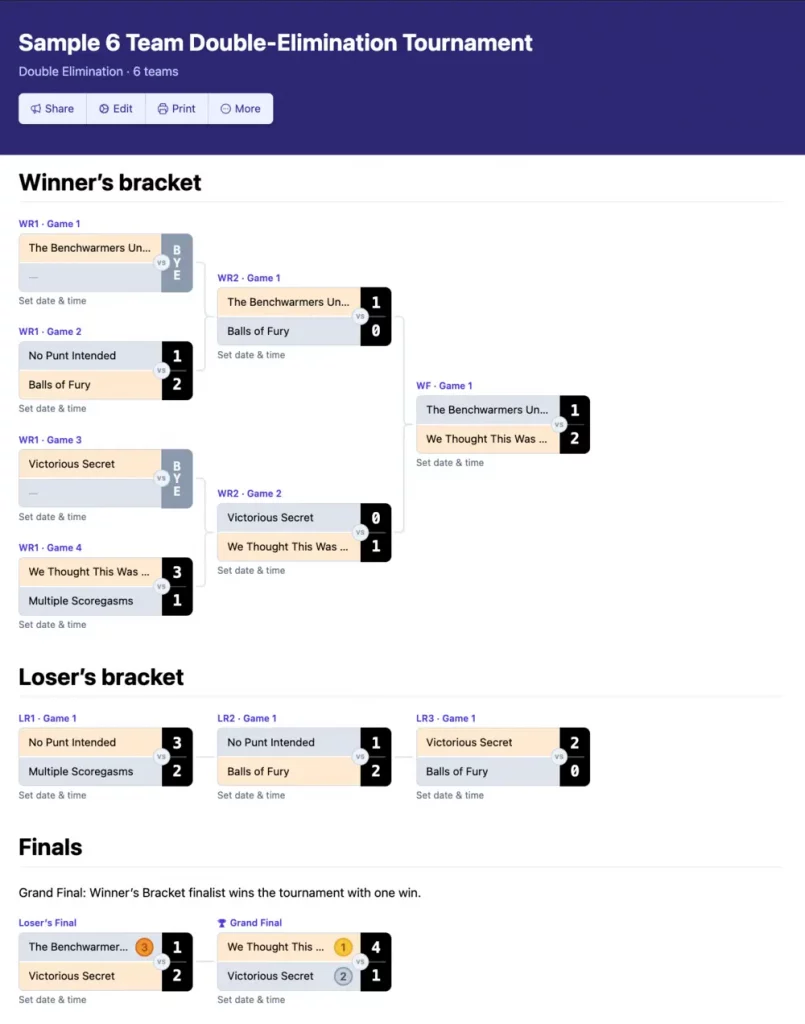
Penjana aplikasi kami menawarkan:
- sebarang bilangan pemain atau pasukan
- pilihan padanan awal fleksibel: seeded, cabutan rawak, atau manual
- Jadual dalam talian dengan kemas kini skor secara langsung
- kemajuan automatik ke perlawanan seterusnya
Start Double-Elimination Tournament
Apakah Kejohanan Penyingkiran Berganda?
Penyingkiran berganda format kejohanan penyingkiran di mana peserta tersingkir selepas dua kekalahan. Peserta masih boleh menang walaupun kalah sekali (berbeza dengan single-elimination format).
Selepas kekalahan pertama, peserta masih mempunyai peluang untuk juara jika mereka menang semua perlawanan seterusnya.
Kelebihan
- Format ini lebih adil berbanding penyingkiran tunggal: satu perlawanan buruk tidak terus menyingkirkan peserta
- Tahap kemahiran dinilai dengan lebih tepat
- Setiap peserta bermain sekurang-kurangnya dua perlawanan.
Kelemahan
- Kejohanan ini mengambil masa lebih lama: jumlah perlawanan hampir dua kali ganda
- Lebih sukar untuk dirancang secara manual
Bagaimana Penyingkiran Berganda Berfungsi?
Secara asasnya, format ini hampir sama dengan penyingkiran tunggal. Namun, begitu, terdapat dua bracket utama iaitu Braket Pemenang and Braket Kalah. Akhirnya, pemenang kedua-dua braket akan bertemu di Grand Final.
Padanan awal
Pertama, peserta dipadankan seperti penyingkiran tunggal:
- Seeded: pemain kuat bertemu di pusingan akhir
- Blind draw: padanan rawak
- Manual: ditentukan oleh penganjur
Braket Pemenang
Kejohanan bermula di Braket Pemenang. Seterusnya, pemenang mara ke pusingan seterusnya. Manakala, yang kalah akan turun ke Braket Kalah.
Braket Kalah
Di Braket Kalah, peserta akan tersingkir jika kalah kali kedua. Sebaliknya, pemenang bracket ini masih berpeluang ke Grand Final.
Grand Final
Di Grand Final, pemenang dan kalah braket akan bertemu. Jika Pemenang Bracket menang, mereka terus dinobatkan juara.
Grand Final Reset
Namun, jika pemenang Braket Kalah menang perlawanan pertama, maka, satu perlawanan tambahan akan dimainkan. Perlawanan ini dipanggil Grand Final Reset. Akhirnya, pemenangnya menjadi juara kejohanan.
Kedudukan
Dalam penyingkiran berganda, empat tempat teratas ditentukan secara automatik:
- Pertama : juara Grand Final atau Reset (jika main)
- Kedua : naib juara (jika main)
- Ketiga : kalah di Braket Kalah Akhir
- Keempat : kalah di perlawanan terakhir Braket Kalah
Jumlah Perlawanan
Secara keseluruhan, format ini mempunyai hampir dua kali ganda perlawanan berbanding penyingkiran tunggal:
| Pasukan | Permainan kurungan pemenang | Permainan kurungan yang kalah | Permainan dalam Pusingan Akhir | Jumlah permainan | Setiap pasukan |
|---|---|---|---|---|---|
| 3 pasukan | 2 | 1 | 1–2 | 4–5 | 2–4 |
| 4 pasukan | 3 | 2 | 1–2 | 6–7 | 2–4 |
| 5 pasukan | 4 | 3 | 1–2 | 8–9 | 2–4 |
| 6 pasukan | 5 | 4 | 1–2 | 10–11 | 2–6 |
| 7 pasukan | 6 | 5 | 1–2 | 12–13 | 2–6 |
| 8 pasukan | 7 | 6 | 1–2 | 14–15 | 2–6 |
| 9 pasukan | 8 | 7 | 1–2 | 16–17 | 2–6 |
| 10 pasukan | 9 | 8 | 1–2 | 18–19 | 2–6 |
| 11 pasukan | 10 | 9 | 1–2 | 20–21 | 2–6 |
| 12 pasukan | 11 | 10 | 1–2 | 22–23 | 2–8 |
| 13 pasukan | 12 | 11 | 1–2 | 24–25 | 2–8 |
| 14 pasukan | 13 | 12 | 1–2 | 26–27 | 2–8 |
| 15 pasukan | 14 | 13 | 1–2 | 28–29 | 2–8 |
| 16 pasukan | 15 | 14 | 1–2 | 30–31 | 2–8 |
| 17 pasukan | 16 | 15 | 1–2 | 32–33 | 2–8 |
| 18 pasukan | 17 | 16 | 1–2 | 34–35 | 2–8 |
| 19 pasukan | 18 | 17 | 1–2 | 36–37 | 2–8 |
| 20 pasukan | 19 | 18 | 1–2 | 38–39 | 2–8 |
| 21 pasukan | 20 | 19 | 1–2 | 40–41 | 2–8 |
| 22 pasukan | 21 | 20 | 1–2 | 42–43 | 2–8 |
| 23 pasukan | 22 | 21 | 1–2 | 44–45 | 2–10 |
| 24 pasukan | 23 | 22 | 1–2 | 46–47 | 2–10 |
| 25 pasukan | 24 | 23 | 1–2 | 48–49 | 2–10 |
| 26 pasukan | 25 | 24 | 1–2 | 50–51 | 2–10 |
| 27 pasukan | 26 | 25 | 1–2 | 52–53 | 2–10 |
| 28 pasukan | 27 | 26 | 1–2 | 54–55 | 2–10 |
| 29 pasukan | 28 | 27 | 1–2 | 56–57 | 2–10 |
| 30 pasukan | 29 | 28 | 1–2 | 58–59 | 2–10 |
| 31 pasukan | 30 | 29 | 1–2 | 60–61 | 2–10 |
| 32 pasukan | 31 | 30 | 1–2 | 62–63 | 2–10 |
Cara Membuat Bracket Penyingkiran Berganda
Dengan penjana kami, prosesnya sangat mudah:
- Pilih pemain atau pasukan
- Masukkan nama peserta
- Guna seeded, secara rawak atau padanan awal manual
Siap! Sekarang anda mempunyai jadual interaktif. Selain itu, peserta akan mara secara automatik apabila skor dimasukkan.
Make Double-Elimination Tournament
Penyingkiran Berganda vs Penyingkiran Tunggal vs Liga Pusingan
Penyingkiran berganda ialah jalan tengah terbaik. Ia lebih adil daripada single-elimination. Ia lebih pantas daripada round robin: Oleh itu, format ini sangat sesuai untuk kejohanan kompetitif, e-sukan dan kejohanan kelab.

