

Our Swiss System Tournament Generator
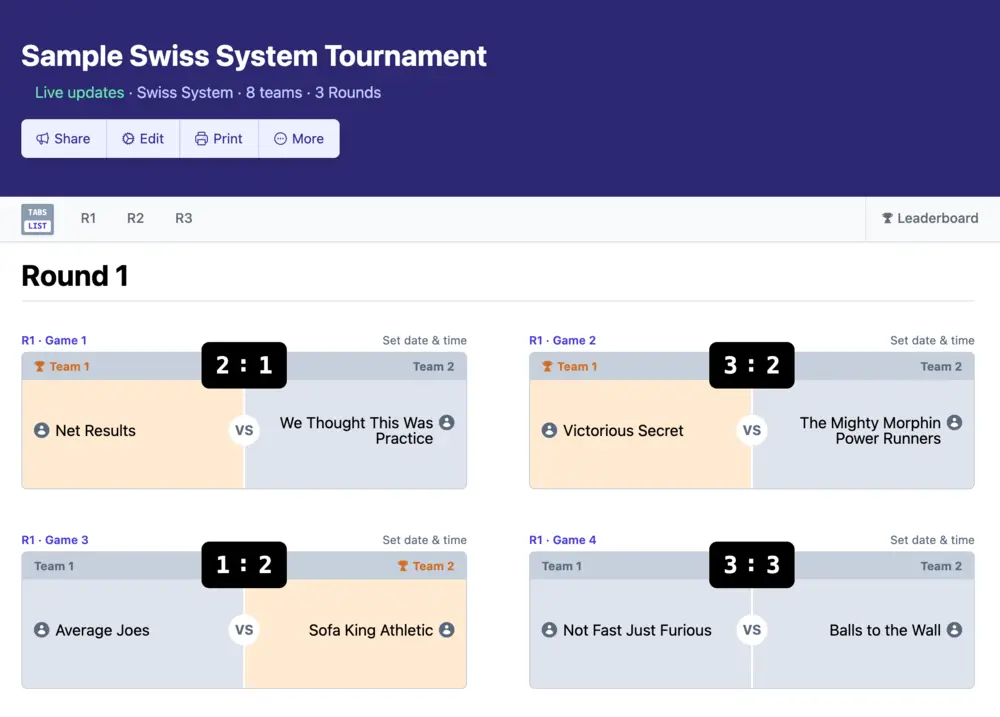
Our bracket maker app can generate a Swiss-style tournament in seconds and supports the following features:
- 1st-round pairing: seeded, blind draw (random), or manual
- Different pairing systems after the 1st round: Dutch, Monrad, or Burstein
- Custom points for win, tie, or loss
- The following tie-breakers: Buchholz, Sonneborn-Berger, head-to-head, number of wins, and goal difference
Moreover, the following features are also supported:
- Dedicated tournament page to share with participants or spectators
- Live score updates
- Presentation mode for large screens in venues
- Export tournament schedule and standings to PDF or CSV
What Is a Swiss System Tournament?
It’s a popular competition format where participants play a fixed number of rounds, facing opponents with similar scores. Each new round is formed based on the results of previous rounds. There is no elimination in Swiss-style tournaments.
This format is very popular in chess, esports tournaments for games like CS:GO, MTG, and Pokémon, as well as amateur sports events and school or club competitions.
How Swiss System Tournaments Work
In Swiss-format tournaments, participants play a predefined number of rounds. After each round is completed, new pairings are generated based on the results of previous rounds.
Participants and Pairings
Teams or players are paired to compete against each other in every round. Initial pairings can be created in one of the following ways:
- Seeded: participants are ranked by skill, split into two groups, and paired accordingly (#1 vs #1, #2 vs #2, etc.)
- Blind draw: participants are paired randomly
- Manual: organizers decide the initial pairings
There is no elimination, so all participants play in every round (except BYEs).
BYEs
If the number of participants is odd, there will be a BYE in each round, which normally awards win points. Each participant can receive a BYE at most once per tournament.
Rounds
There are several ways to calculate the required number of rounds based on the number of participants, but they are all based on the following formula:
⌈log2(N)⌉
Where N is the number of participants and “⌈ ⌉” means rounding up. In practice, there are usually three options:
-
⌈log₂(N)⌉: fast option with fewer rounds, but enough to determine a winner
-
⌈log₂(N)⌉ + 1: standard option that produces reliable rankings
-
⌈log₂(N)⌉ + 2: extended option for maximum accuracy
Below you can find the number of rounds and games based on the number of teams.
| Team | Rounds | BYEs | Games |
|---|---|---|---|
| 3 teams | 2 | 1 | 1–2 per team, 2 total |
| 4 teams | 2 | — | 2 per team, 4 total |
| 5 teams | 3 | 1 | 2–3 per team, 6 total |
| 6 teams | 3 | — | 3 per team, 9 total |
| 7 teams | 3 | 1 | 2–3 per team, 9 total |
| 8 teams | 3 | — | 3 per team, 12 total |
| 9 teams | 4 | 1 | 3–4 per team, 16 total |
| 10 teams | 4 | — | 4 per team, 20 total |
| 11 teams | 4 | 1 | 3–4 per team, 20 total |
| 12 teams | 4 | — | 4 per team, 24 total |
| 13 teams | 4 | 1 | 3–4 per team, 24 total |
| 14 teams | 4 | — | 4 per team, 28 total |
| 15 teams | 4 | 1 | 3–4 per team, 28 total |
| 16 teams | 4 | — | 4 per team, 32 total |
| 17 teams | 5 | 1 | 4–5 per team, 40 total |
| 18 teams | 5 | — | 5 per team, 45 total |
| 19 teams | 5 | 1 | 4–5 per team, 45 total |
| 20 teams | 5 | — | 5 per team, 50 total |
| 21 teams | 5 | 1 | 4–5 per team, 50 total |
| 22 teams | 5 | — | 5 per team, 55 total |
| 23 teams | 5 | 1 | 4–5 per team, 55 total |
| 24 teams | 5 | — | 5 per team, 60 total |
| 25 teams | 5 | 1 | 4–5 per team, 60 total |
| 26 teams | 5 | — | 5 per team, 65 total |
| 27 teams | 5 | 1 | 4–5 per team, 65 total |
| 28 teams | 5 | — | 5 per team, 70 total |
| 29 teams | 5 | 1 | 4–5 per team, 70 total |
| 30 teams | 5 | — | 5 per team, 75 total |
| 31 teams | 5 | 1 | 4–5 per team, 75 total |
| 32 teams | 5 | — | 5 per team, 80 total |
Scoring System
Normally, participants receive the following points per game:
- 3 points for a win
- 1 point for a tie
- 0 points for a loss
Standings and Rankings
During the tournament and in the final standings, participants are ranked by points earned. If multiple participants have the same number of points, tie-breakers are used.
Swiss System Tie-Breakers
- Buchholz: sum of opponents’ scores
- Sonneborn-Berger: opponents’ scores weighted by match results
- Head-to-head: direct match result between tied participants
- Number of wins: more wins rank higher
- Goal difference: goals scored minus goals conceded
Swiss System vs Round Robin vs Elimination
Swiss vs Round Robin
As in the round robin format, there is no elimination, but participants do not play against every other participant. This keeps everyone engaged while requiring far fewer games and rounds than round robin tournaments.
Swiss vs Single Elimination
A Swiss tournament is almost as fast as a knockout format, but it is more forgiving and produces more accurate rankings while still reliably determining a winner.
Advantages and Disadvantages of Swiss Tournaments
Advantages
- Scales well to large numbers of participants, including dozens or even hundreds of players
- More efficient than round robin, producing reliable rankings with far fewer games
- No elimination: everyone plays in every round
- Excellent balance between speed and fairness
Disadvantages
- With too few rounds or many participants, it may not produce a single clear winner
- Relies heavily on tie-breakers
- Too complex to manage manually without software
How to Organize a Swiss Tournament
Organizing a Swiss tournament doesn’t have to be complicated. Our Swiss System Tournament Generator automatically handles pairings, standings, scoring, and tie-breakers, so you don’t have to calculate anything manually. Spend less time on setup and admin work — and more time running a smooth, fair tournament!
